Six Sigma (6σ) is a quality management methodology and a set of tools that use data analysis for process improvement and error reduction. It was developed by Motorola in the 1980s and has since been incorporated by many organizations in various industries.
Six Sigma uses a data-driven approach and statistical methods to identify and eliminate defects and errors in a process. Its goal is to achieve a process performance level of no more than 3.4 defects per million products or services produced.
The Six Sigma Methodologies
The two main methodologies of Six Sigma are the DMAIC process and the DMADV process.
DMAIC Process
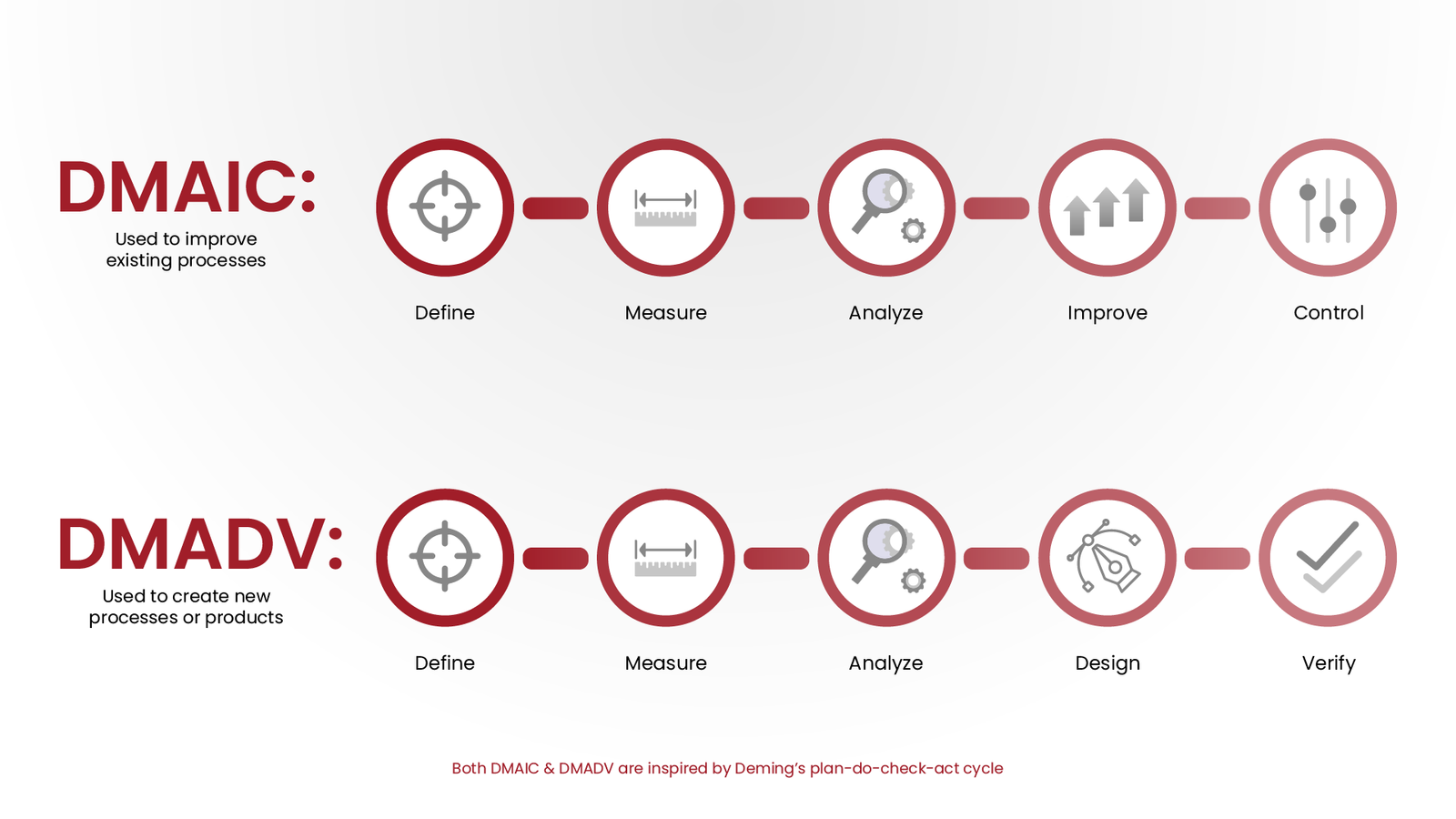
The DMAIC process is the Six Sigma process that is used to improve existing processes. It stands for Define, Measure, Analyze, Improve, and Control.
- Define – Define the problem and set clear goals. Identify the problem or opportunity for improvement and establish specific, measurable goals for the project.
- Measure – Measure the current performance. Collect and analyze data to understand the current performance of the process.
- Analyze – Analyze the data. Use statistical tools to identify the root cause of the problem and potential solutions.
- Improve – Improve the process. Implement solutions to improve the process and eliminate the root cause of the problem.
- Control – Monitor the process to ensure the improvements are sustained and the problem does not reoccur.
DMADV Process
The DMADV, stands for Define, Measure, Analyze, Design, and Verify and is also known as DFSS (Design for Six Sigma) process. It is a methodology used to design new processes or products.
- Define –Organizations must identify problems, define goals, and establish strategies to fulfill their needs.
- Measure – Collect data and measure the process to determine and evaluate its performance.
- Analyze – Analyze data to detect any problems or irregularities and to generate the best design concepts for the final design phase.
- Design – Create a new design based on the information gathered from the analysis phase.
- Verify – Test and validate the new design to ensure it meets the goals, needs, and requirements.
DMAIC and DMADV are two distinct approaches that differ from each other (see the graph below). On one hand, DMAIC is primarily concerned with improving existing processes, whereas, on the other, DMADV is a proactive approach focused on improving the quality of new processes and products, as well as eliminating potential problems before they occur.

Six Sigma Key Tools and Techniques
There are several key tools and techniques used in the Six Sigma methodology to help identify and eliminate the causes of defects and variability in a process. Some of the most used tools and techniques include:
- Statistical Process Control (SPC) – It uses statistical techniques to monitor processes over time and identify patterns or trends that indicate a problem.
- Fishbone Diagram (Ishikawa Diagram) – Is used to identify the root cause of a problem by breaking it down into smaller parts and analyzing the relationships between many factors.
- Pareto Chart – Is a chart that contains bars and a line graph used to identify the most critical problems or issues in a process by ranking them in terms of their impact.
- Flowchart – Is used to visualize the flow of a process and identify areas where improvements can be made.
- Control Chart – Is used to detect whether a process is stable or not by monitoring the process over time and identifying any changes that might indicate a potential problem.
- Capability Analysis – Is a statistical tool used to evaluate the performance of a process and determine if it is capable of meeting customer requirements.
- Design of Experiments (DOE) – Is used to test different process variables and identify the optimal combination of inputs to achieve the desired outcome.
- Failure Modes and Effects Analysis (FMEA) – Is used to discover potential failures in a process and assess the potential impact of each failure mode.
- 5 Whys – Is a method used to analyze and solve problems by asking the question “why” at least five times.
Six Sigma Implementation
To implement Six Sigma, it is important that organizations take the following steps:
- Assess the organization’s readiness for Six Sigma – Organizations should consider several factors which indicate their readiness for such a change. For example, they should evaluate their leadership commitment, organizational culture, resources, etc.
- Identify potential Six Sigma projects – Before implementing Six Sigma projects, organizations should identify their business needs, collect and analyze data, define project goals, evaluate risks, and prioritize projects.
- Choose the right team members – When choosing the team, organizations should consider their members’ expertise, knowledge, training, management skills, etc.
- Develop a project charter – A project charter serves as a working document used to set the directions of the project and define its goals, scope, roles and responsibilities, timeline define, measures of success, etc.
- Communicate the Six Sigma initiative to employees – Leaders should communicate to their employees and explain to them what is Six Sigma and its importance, how it will affect them, what are their roles and responsibilities, and other aspects of it. They should provide continuous support for their employees as well.
Most Important Benefits of Six Sigma
Some of the most important benefits of Six Sigma are:
- Increased quality, efficiency, and productivity
- Reduced costs and defects
- Improved employee morale and engagement
- Enhanced customer satisfaction
- Improved time management
The Importance of Six Sigma in Today’s Business Environment
In today’s fast-paced and competitive business environment, companies that can quickly respond to changing customer demands, reduce waste and improve quality, have a significant advantage.
Six Sigma provides them with a structured and systematic approach to process improvement which helps them deliver better results, enhance processes, and stay competitive.
Six Sigma Trainings
Six Sigma training courses are designed to equip individuals with the necessary expertise to understand and implement Six Sigma processes. PECB offers Six Sigma Yellow Belt and Six Sigma Green Belt training courses which help professionals develop their skills and gain the needed knowledge. A Six Sigma certificate can benefit professionals by improving their management, leadership, risk assessment, strategic, financial, and team-building skills.
About the Author
Vlerë Hyseni is the Digital Content Officer at PECB. She is in charge of doing research, creating, and developing digital content for a variety of industries. If you have any questions, please do not hesitate to contact her at: content@pecbweb.com.